SEO & Websites · Decision guide
Website for the UAE market: English, Arabic or German?
The language of a website is a sales decision. It should reflect the language in which buyers search, review documents, and discuss a vendor internally.
A German company should choose site languages from the buying process it can document and maintain.
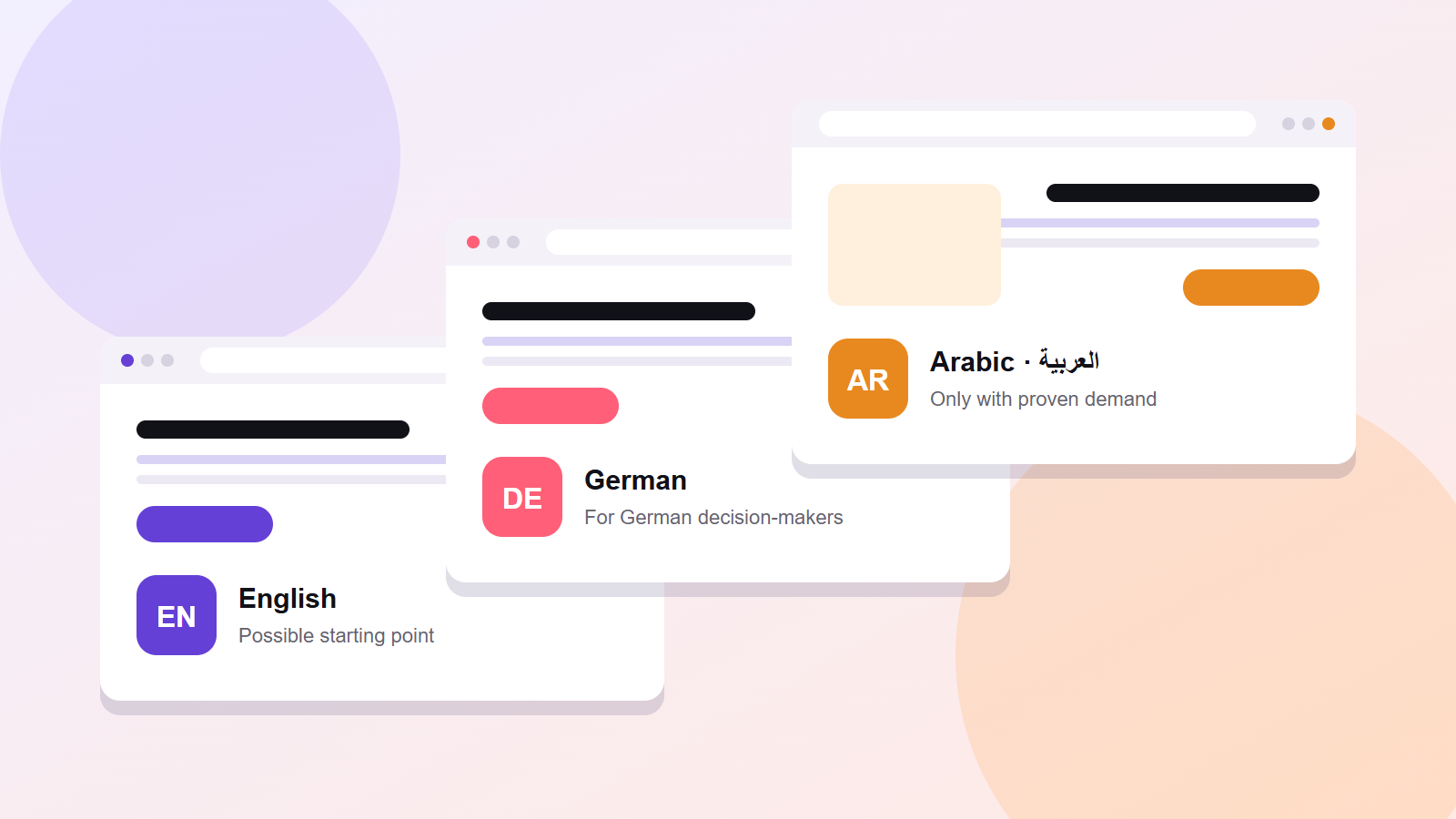
Languages
Each language version needs its own maintenance and a clear target group.
Short answer
Short answer
For the UAE market, English can be a practical start if the defined buying team demonstrably uses it. German can serve a separate decision path for German companies. Arabic should only appear when the target group and ongoing expert maintenance are secured.
English as a testable starting hypothesis
English can be the first working version if the named buying team demonstrably searches, evaluates and communicates in English. Check search results, conversations and document requests for this. A generic English page without evidence about the target group remains an assumption.
German for the German decision-making phase
German makes sense when a German owner, export manager or sales partner is preparing market entry. This page answers different questions: How do I check demand? Which website do I need? How do I get first conversations? It is not a translation of the English Dubai page.
Arabic only with professional care
Arabic can be important if the specific target group communicates predominantly in Arabic. A one-off translation without local technical review is worse than a well-maintained English page. Only start an Arabic version if someone is permanently responsible for content, queries and updates.
The official language is not automatically the buyer's language
Arabic is the official language of the UAE. The UAE government also points out that road, traffic and business signage appears in Arabic and English. This indicates the presence of both languages, but not a blanket language preference of a B2B purchasing team. UAE Government: UAE fact sheet ↗
Google recommends separate URLs for different language versions. hreflang can mark genuine language or regional variants; each version should reference itself and the alternatives. hreflang does not translate content and does not make up for an incomplete page. Google Search Central: Managing multi-regional and multilingual sites ↗
Language decision with four pieces of evidence
Choose the first language not by country, but by how the specific buying team demonstrably works.
| Question to check | Possible evidence | Consequence |
|---|---|---|
| In which language do buyers search? | Search Console, SERP research | Language of the entry page |
| In which language is the offer evaluated? | Document requests, interviews | Language of data sheets and FAQs |
| In which language are deals negotiated? | Sales notes | Contact and quotation process |
| Who maintains the version? | Designated responsible person | Publish only languages you can maintain |
English only as an evidenced working hypothesis
English can be a sensible first version if the defined buying team demonstrably searches, evaluates and communicates in English. Without this evidence, it remains an assumption to test.
Practical process
- Determine the language based on the person searching and deciding.
- Use separate URLs per language; do not hide translations behind browser-language detection.
- Publish only versions you can update when products, contacts or offers change.
Frequently asked questions
Does every page have to exist in all languages?
No. An alternative language version makes sense when it does the same job for another language group and can be maintained.
What does hreflang mean?
hreflang is a signal to Google about genuine language or regional variants of a page. Both pages must reference each other.