SEO & Websites · Decision guide
.ae or .com for Dubai: Which domain suits the website?
Published:
Anyone planning a website for Dubai quickly runs into the question of whether an .ae domain is necessary. Most guides on this come from domain providers and, predictably, answer yes. For a German company, however, the answer depends on who runs the site, who it is aimed at and how much visibility has already been built up.
A German company should pick the domain from its real starting point: where buyers are, which entity operates the site and how much a second site can be maintained.
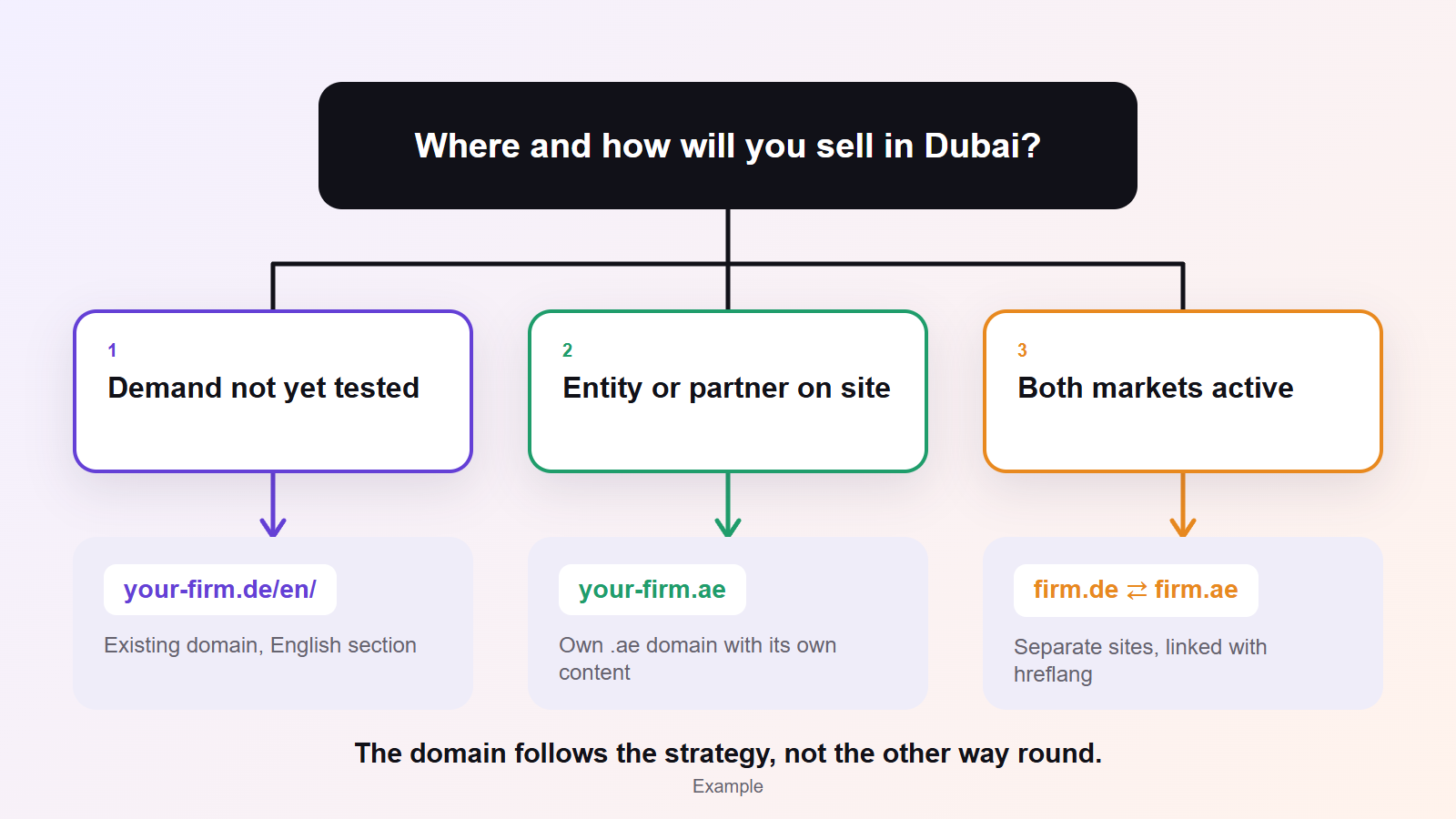
Domain choice
English section on the existing domain
Own .ae domain with its own content
Separate sites, connected by hreflang
Keep the domain, do not move
The domain ending follows from the strategy; it is not where the strategy starts.
Short answer
Short answer
An .ae domain is worth it if you operate in the UAE and target customers there. To test demand, an English section on your existing domain is usually enough. Google does not document a ranking advantage from the ending alone.
What Google says about the country ending, and what it does not
In its documentation on multilingual and multi-regional websites, Google describes domains with a country ending, so-called ccTLDs, as a strong signal that a site is meant for a specific country. Domains such as .com, by contrast, are not tied to a place. If you want to address a country with such a domain, you have to make the target clear in other ways, for example through hreflang annotations and a suitable site structure.
What matters is what is not stated there. The country link does not imply a general ranking bonus. The claim that .ae domains generally rank better in the Emirates than .com domains comes from guides by providers who sell .ae domains. Google also explicitly says server location is not a definitive signal. Hosting in Dubai therefore does not replace a clean country setup.
Who may register an .ae domain
The .ae ending is administered by .aeDA, which belongs to the Telecommunications and Digital Government Regulatory Authority (TDRA). In the published eligibility policy (AEDA-POL-007), a domain directly under .ae counts as "unrestricted": applicants do not have to provide any documentary evidence. Registration runs through accredited registrars, which the TDRA lists on its website.
The subzones are stricter. According to the policy, a .co.ae domain is meant for commercial companies operating in the UAE. Registrants need either a valid UAE trade licence under company law (for example as an LLC) or a trademark application or trademark in the UAE. The domain name must match the company name or the trademark. Free-zone companies are not eligible for .co.ae. The policy carries an issue date of 21 April 2008, so check with the registrar before ordering that the conditions still apply.
For a German company without a legal entity in the UAE, this means a plain .ae domain is within reach. A .co.ae address requires a local licence or trademark.
Three typical starting points
First: a German company is still checking whether there is demand in Dubai. The existing domain with its own English-language section, for example under /en/ or /ae/, is usually enough. Google describes subdirectories on a gTLD as easy to set up and low-maintenance. The drawbacks are a single server location and a less clear separation of country versions. Both are tolerable in a test. The authority of the existing domain is kept, and the test costs neither a move nor a second site.
Second: the company has an entity or a fixed distribution partner in the UAE and mainly addresses customers there. Then an own .ae domain with its own content can make sense. It signals the country focus to visitors and search engines. It does, however, need its own content, its own maintenance and its own links, otherwise you end up with only a thin second site.
Third: both markets are served at the same time. Then the German and the Emirati site run separately, and hreflang connects the two versions. Google requires versions to link to each other. If only one page points to the other, the annotations are ignored. Each version also lists itself. The value x-default marks the fallback page.
Why a domain change costs more than it seems
If you move an existing website to a new domain, you must redirect every old address to the matching new address with a 301 or 308. Google recommends keeping these redirects for at least a year, preferably longer. For a move to a different domain, Search Console also offers the Change of Address tool. Expect temporary fluctuations in visibility while Google recrawls the new addresses.
This is manageable, but it is work and a risk for a site that already brings enquiries. Moving only because of the domain ending is therefore rarely worth it. If you are not using the domain yet, the choice is open.
How to decide
First clarify who is actually supposed to buy in Dubai, and whether that needs a separate presence. Then check whether a local entity or trademark exists, because the choice of ending depends on it. Finally decide by effort: a second domain needs content and maintenance permanently. If the resources are missing, a well-made English section on the existing domain is better than an empty .ae site.
Register the .ae address of your brand name regardless, if it is available. It protects against confusion and costs little. It creates no obligation to use it.
What is documented and what remains sales copy
In its documentation on multilingual websites, Google calls country endings a strong signal for a target country and describes .com as location-independent. A general ranking advantage in a country is not claimed there.
According to the .aeDA eligibility policy (AEDA-POL-007), anyone may register a domain directly under .ae without evidence. For .co.ae, a trade licence in the UAE or a trademark there is required, and the name must match the company. Free-zone companies are excluded. The document is dated 21 April 2008.
For moves to a new domain, Google recommends permanent redirects for at least a year, the Change of Address tool in Search Console and patience with temporary fluctuations.
Domain decision by starting point
Match your project to a row. The recommendations are editorial judgements, not Google requirements.
| Initial situation | Recommendation | Reason |
|---|---|---|
| Demand in Dubai not yet tested | English section on the existing domain | No move, authority is kept |
| Entity or partner on site, UAE focus | Own .ae domain with its own content | Clear country focus for customers and search engines |
| Both markets active | Separate sites with hreflang | Each audience gets suitable content |
| Existing site that already brings enquiries | Keep the domain | A move risks visibility without a gain |
What this comparison cannot do
No guide can promise that an ending alone improves rankings. Check your decision against search queries, page views and enquiries from the UAE. The .aeDA policy dates from 2008. Have the registrar confirm the current conditions.
Practical process
- Clarify who should buy in Dubai and whether that needs a separate presence.
- Check whether you have a legal entity or trademark in the UAE. .co.ae depends on it.
- If demand is uncertain, start with an English section on the existing domain.
- Connect several versions with reciprocal hreflang annotations.
- Secure the .ae address of your brand name, even if you do not use it yet.
Frequently asked questions
Do I need an .ae domain to be found on Google in Dubai?
No. Google describes country endings as a strong signal of country focus but does not rule out other endings. If you use a .com or .de domain, you have to make the country focus clear through structure and hreflang.
Can a German company register an .ae domain?
According to the .aeDA policy, a domain directly under .ae is unrestricted and needs no evidence. For .co.ae, a trade licence in the UAE or a trademark there is required. Free-zone companies are excluded from .co.ae.
What happens to visibility when you change domains?
Google recommends permanent redirects from every old address to the new one, for at least a year. Temporary fluctuations are normal until the new addresses have been recrawled.