Dubai SEO · Decision guide
Arabic or English website for Dubai: which languages do you need?
Published:
Arabic is the official language of the UAE, yet much of Dubai's business life runs in English. So does your website need an Arabic version? The honest answer depends on who searches for you, in which language, and whether you can keep a second language site accurate. A weak Arabic copy can do more harm than none.
Language check
- 01Searchers
Which language do buyers actually search in?
- 02Structure
Separate URLs and hreflang in both directions
- 03Build
dir and logical CSS from the first template
- 04Text
Native-quality Arabic, reviewed for the key pages
An unchecked translation is worse than a strong English page.
Short answer
Short answer
Build the Arabic version when your buyers search in Arabic and you can keep it accurate. Otherwise a strong English site comes first. In both cases use separate URLs per language, hreflang in both directions and native-quality text.
Start with the searcher, not the country
Arabic is the official language of the Federation. That fact explains why Arabic matters, but it does not tell you what your customers type into Google. A company selling cloud services to multinational offices in Dubai may find that its buyers search and read in English. A clinic, a legal service or a retailer serving Emirati families may reach more people in Arabic.
Check your own data before deciding. Look at the languages your current visitors use in browser settings and in Search Console query reports, and ask your sales team which language buyers use on the phone and in emails. Then look at the results page. Search for your main service once in English and once in Arabic. If the Arabic results show real competitors, there is demand worth serving. If the page is empty or filled with unrelated results, an Arabic site may not be your first priority.
What Google needs from a bilingual site
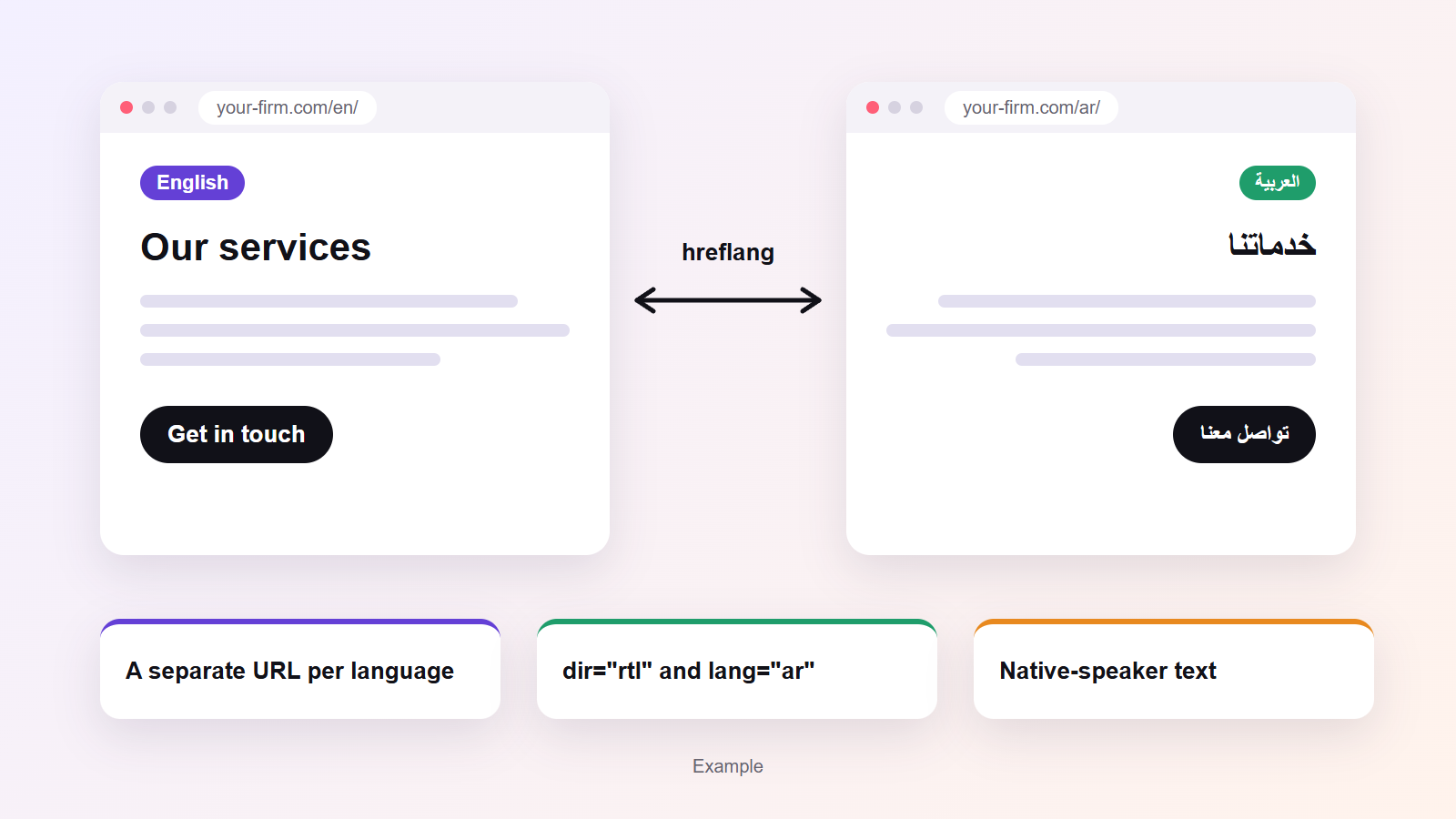
Google recommends a separate URL for each language version of a page, for example /en/ and /ar/. Each version should point to the others with hreflang annotations, and each one must list itself as well. If two pages do not link to each other, Google ignores the tags. The reserved value x-default marks the fallback page for visitors whose language matches none of your versions. Arabic uses the language code ar, and a region such as AE can be added to it.
Avoid sending visitors automatically to one version based on a guess about their language or location. Google advises against redirecting users on that basis and against adapting content by IP address. Let people switch language with a visible link instead.
Translating only the menu and footer while the main content stays in English does not make an Arabic page. Google points out that such pages offer a poor experience when the bulk of the content remains in one language.
Right-to-left is a build decision
An Arabic page needs the right language and the right direction. The W3C advises setting dir="rtl" on the html element together with lang="ar", because direction is not implied by the language code. It also recommends logical CSS properties such as margin-inline-start instead of margin-left, so that the layout mirrors by itself.
This is far cheaper to do when the English site is first built. Retrofitting right-to-left support into a template full of fixed left and right values means reworking components one by one. If you plan an Arabic version later, ask your developer to use logical properties from the start.
Machine translation and thin pages
A quick machine translation of every English page is tempting. Google's spam policy on scaled content abuse lists producing many pages through automated transformations, including translating, where little value is provided to users. A single carefully reviewed service page is not that. Hundreds of unreviewed translated pages are exactly what the policy targets.
Have a native Arabic speaker with subject knowledge write or review the pages that matter: the core services, the contact page and the pages that win enquiries. Keywords in Arabic need their own research. A literal translation of an English keyword is often not the phrase people use.
A law may change the rules for Arabic content
A media report from May 2026 describes a planned Arabic language law, expected to come into force after further preparation. It mentions Arabic in public advertising campaigns and Arabic-speaking staff in customer-facing organisations. The report does not mention websites, and it says the law was still in development. Treat it as a signal to watch, not as a current rule, and check its status with legal counsel before building a compliance plan around it.
What the primary sources say
Google recommends using different URLs for each language version of a page and linking the versions with hreflang. Each version must list itself and all others, otherwise the tags are ignored. The value x-default marks a fallback version.
Google advises against redirecting users automatically on a guess about their language and against using IP analysis to adapt content. It also says that translating only the template while the main content stays in one language creates a poor experience.
The W3C advises dir="rtl" on the html element for Arabic, a separate lang attribute, and logical CSS properties such as inline-start and inline-end instead of left and right.
Language decision table
Match your situation to a row. The recommendations are editorial judgements built on the sources above.
| Your buyers | First step | Watch out for |
|---|---|---|
| International firms and expatriates | Strong English site | Add Arabic later, with logical CSS from day one |
| Local consumers or public bodies | English and Arabic for key pages | Native-quality text, separate keyword research |
| Mixed audience | English first, Arabic for top service pages | Do not translate everything at once |
| No evidence yet | Compare English and Arabic search results | Decide on data, not assumption |
What this guide cannot decide for you
Search volume in Arabic for your service may be small or large, and no general article can tell you. Measure it with your own queries and visitor data. Legal duties for Arabic content can change, so confirm them with qualified counsel.
A practical process
- Check which language your visitors and buyers use, and search your service in English and Arabic.
- Decide the languages for the pages that win enquiries first.
- Use separate URLs, hreflang and a visible language switch.
- Build the template with dir and logical CSS properties.
- Have a native speaker write or review the Arabic text.
Questions readers ask
Is an English-only website enough for Dubai?
It can be, when your buyers are international businesses and expatriates who search in English. Check your own search data and the Arabic search results for your service before deciding.
Should I redirect visitors to Arabic automatically?
No. Google advises against redirecting users automatically based on a guess about their language and against using IP analysis to adapt content. Offer a visible language switch.
Is an automatic translation of my site safe for SEO?
Not at scale. Google's spam policy names mass-producing pages through automated translation with little value to users as scaled content abuse. Review and edit the pages that matter.