
UAE market entry · Guide
Win customers in Dubai: from a first sign of demand to the first order
The route to Dubai often starts by chance: an enquiry through the website, a contact at a trade fair, a German customer with a project in the Gulf. That quickly turns into a plan to “open up the market”. The calmer route: first check whether there really are buyers for one specific offer, then approach the first ten companies in a targeted way, and only then put money into a website, staff or a company.
Translated from German, reviewed by hand. This guide was written for German B2B suppliers looking for their first customers in Dubai. Read the German original
B2B roadmap
Name a role, an industry and a specific problem.
Show the service, delivery model and limits on one focused page.
Record each enquiry with its source and next step.
Only real feedback shows whether the hypothesis holds.
Market entry is not yet evidence of customer demand.
Short answer
First test a single buyer hypothesis with search, target companies and conversations. Then approach ten companies in a targeted way, with a small test page for exactly this use case. Only recurring demand justifies an office, staff or a company in Dubai.
Who buys from a German B2B supplier in Dubai?
The answer depends heavily on the industry, but four buyer types are typical. Traders and distributors buy, stock and resell. General contractors and consultants bring suppliers into large construction projects. Operators of plants, buildings or fleets look for spare parts, maintenance and upgrades. And public bodies buy through their own portals and tenders.
For each of these types, the route to an order looks different. A distributor wants margin, exclusivity and reliable delivery times. An operator wants to know who can be reached when something breaks. A general contractor asks about approvals and references. Ignore these differences and you write a website and sales emails for “companies in Dubai” – and reach no one in particular.
Test demand first, then invest
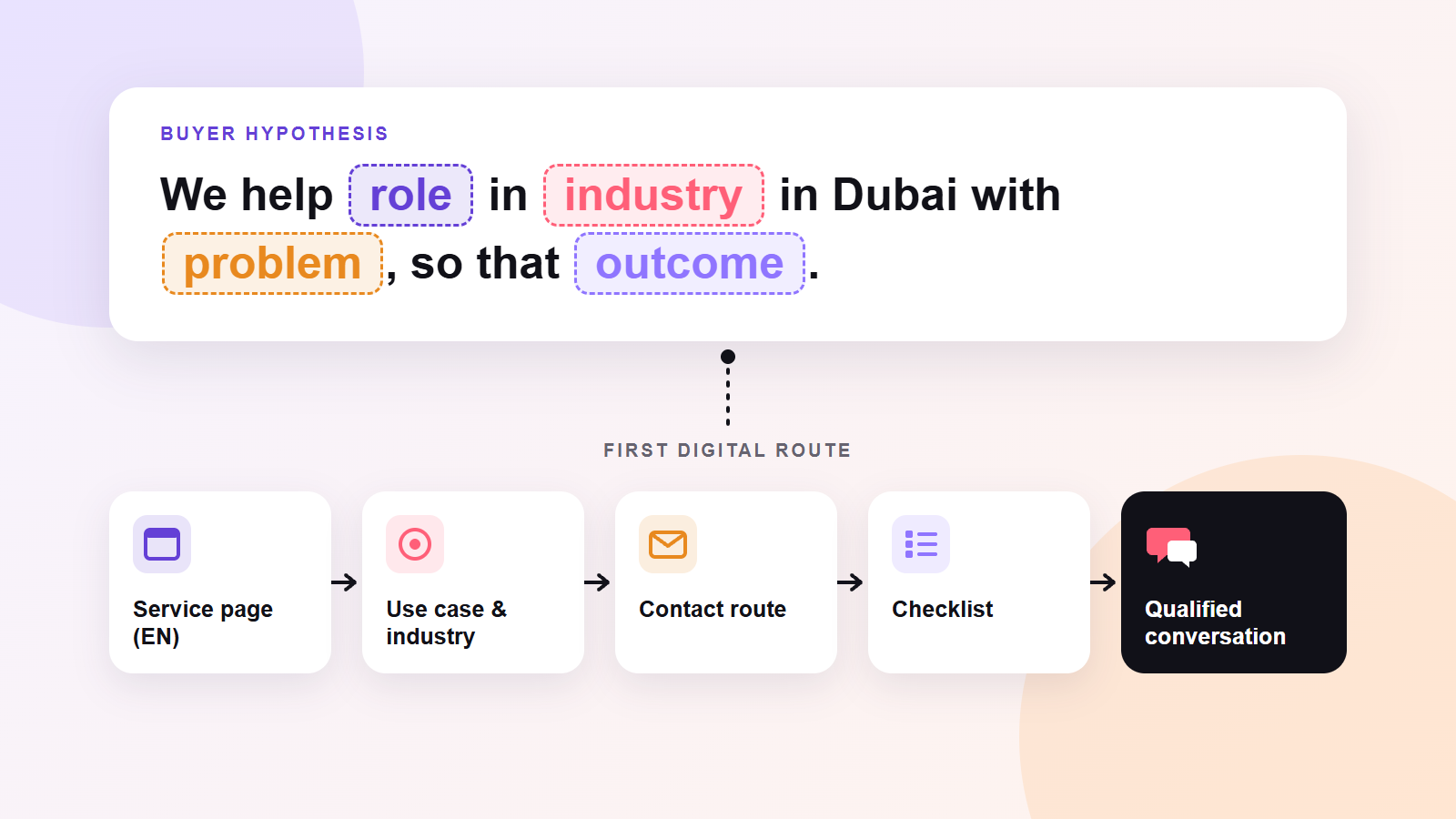
Write a single buyer hypothesis in one sentence: “We help [role] in [industry] in [place] with [problem] so that [result].” Example: “We help data-centre operators in Dubai monitor the cooling of their server rooms without gaps.” This sentence is what you test – not the entire product portfolio.
Then test the hypothesis from three directions. First, search: which English terms do buyers use, and which suppliers, directories or distributors appear on Google for this task? Second, target companies: are there enough firms that can actually have the problem? Third, conversations: do people from these firms confirm the problem, the timing and who decides?
Only when all three sources point the same way is a bigger step worthwhile.
Find the first ten target customers
A short, well-reasoned list is worth more than a purchased database. Good sources are exhibitor lists of trade fairs in Dubai and reference lists on the websites of general contractors and operators. Membership of chambers and industry bodies also helps to place a company.
For each firm, note why it is on the list, which role your contact would have and which event could trigger a conversation: a new project, an expansion, a change of supplier. Dubai Chambers and the German Chamber of Commerce abroad (AHK UAE) also offer formats that arrange contacts. A separate article explains how business matching works.
A small test page instead of a big relaunch
Before you build a complete English website, one page for the chosen use case is enough. It needs a clear headline with the buyer's problem, a short description of who the offer is for, the process up to delivery, proof such as a data sheet or reference, and an easy question to answer: a short first call or a download.
This page is a tool, not a showcase. You link to it in your messages to the ten target customers and see which wording triggers questions. The article on a landing page for Dubai explains how such a page is built in detail.
From contact to qualified conversation
Run every conversation with the same questions: how do you solve the problem today? What does it cost when it occurs? Who decides on a new supplier, and through which procedure? Is there a date by which a decision is due? After each conversation, record the answers in a simple table.
Example: after eight conversations, five operators confirm the problem, but only two have a budget for it, and both buy through a local distributor. That is not a failure but a clear decision: the next step is to look for a suitable distribution partner, not to set up your own company.
Plan around the calendar as well. During Ramadan, working days in the private sector are shorter, and many decisions pause around the Eid holidays. Our Dubai calendar shows which weeks are affected in 2027.
When the next big step makes sense
Your own company, an office or an employee on the ground only pay off once recurring orders or a concrete project carry them. Until then you can deliver from Germany, sell through a distributor or start with a free zone company. The articles on free zone versus mainland and on taxes on business with Dubai explain what the legal form means for sales and tax.
Questions about winning customers in Dubai
Do I need a company in Dubai to win customers there?
Not at the start. A common start is delivering from Germany or through a local distributor. Your own company pays off once recurring orders carry it or customers explicitly require a contracting party on the ground.
How many conversations do I need before deciding?
There is no fixed number. What matters is whether the answers repeat: if several companies name the same problem, a budget and a decision route, you have a solid basis. If the answers contradict each other, sharpen the hypothesis first.
Where do I get the first contacts?
Good starting points are exhibitor lists of trade fairs in Dubai, reference lists of general contractors, the formats offered by Dubai Chambers and the AHK UAE, and your own network of German customers with projects in the Gulf.
Which trade fairs in Dubai suit a first step?
That depends on the industry: Dubai hosts international trade fairs for technology, food, construction and many other sectors. Choose a fair where your target customers exhibit or buy, and arrange meetings beforehand. The article on B2B leads in Dubai describes which fairs these are and how to follow up.