UAE → Germany · Decision guide
English or German website for the German market?
English can be tested when the defined audience demonstrably works in English. A German page is justified when German-language search results, enquiries, sales notes or interviews show that the buyer searches, compares or asks commercial questions in German.
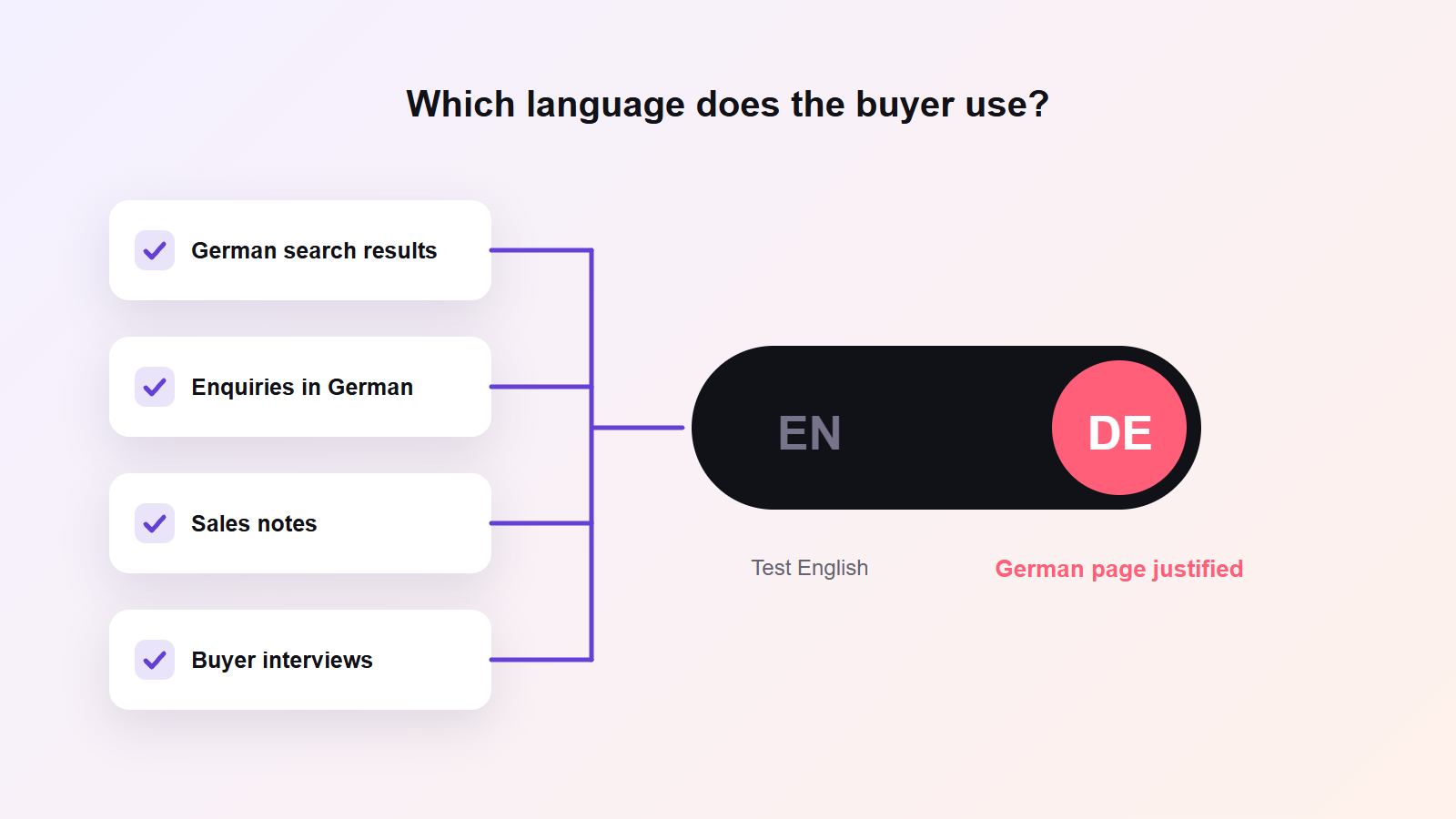
Language choice
Publishing more languages creates a maintenance obligation.
Short answer
Use German when the target buyer researches and compares the offer in German. Use English as an initial route when the audience demonstrably works in English. Publish only the language versions you can maintain accurately.
Check the buyer’s working language
Look at trade publications, competitor pages and outbound conversations. If the buyer’s problem and procurement vocabulary appear in German, an English-only page creates friction. If the work is global and technical, English may be sufficient for the first test.
Translate the decision, not the text
A useful German page needs the German term for the problem, local units or standards where relevant, a clear contact path and an honest explanation of delivery. Literal translation can keep the grammar while losing the commercial meaning.
Publish only what you can maintain
A short, accurate German route for one offer is better than fifty unmaintained translations. Start with pages that have a real buyer and refresh them when product facts, availability or contact details change.
Make language a measurable decision
Google recommends separate URLs for language versions and allows hreflang to identify true localized alternatives. Each version should reference itself and the alternatives. Google determines page language from visible content, so translating only navigation does not create a German page. Google Search Central: Managing multi-regional and multilingual sites ↗
English can be tested first only when the identified audience demonstrably searches, evaluates and communicates in English. Evidence can come from German result pages, enquiry language, sales notes, trade publications and interviews. A sector label alone is not enough.
Germany Trade & Invest provides information and assistance for foreign companies considering establishment in Germany. Its role is useful context for market-entry research but does not establish the language preference of your buyers. Germany Trade & Invest: Investor's Basics 2026 ↗
Language decision tree
Choose a language at the level of one buyer journey, not for an entire country.
| Evidence | Decision | Implementation |
|---|---|---|
| German queries and commercial questions | Create the German path | Original German copy and maintained facts |
| Audience works demonstrably in English | Test English first | Record query and enquiry language |
| Same page exists in both languages | Connect equivalents | Separate URLs plus reciprocal hreflang |
| Only some topics need German | Translate selectively | Do not force one-to-one article pairs |
| No owner for updates | Delay the version | Avoid stale product and contact facts |
Language does not guarantee ranking
A German page is not entitled to rank because it is German. It still needs a distinct purpose, useful information, technically accessible URLs and evidence that the target audience uses that language.
A practical process
- Inspect the language used by buyers, trade media and search results.
- Translate the commercial decision and technical terms, not just existing English copy.
- Use a distinct URL per language and connect true equivalents with hreflang.
Questions readers ask
Can I translate only the navigation?
No. Google determines page language from the visible main content. A translated template around English content does not make a German page.
Should I automatically redirect visitors by browser language?
Give people a visible choice. Search crawlers may not see every dynamically served variation.